Last Updated: November 2, 2026
Quick Summary
Canyon Dental is a Save Dental alternative for sedation dentistry in Orem, offering nitrous oxide, oral conscious sedation, and IV sedation provided in-house by a certified team. Your consultation, treatment, and follow-up are handled under one roof, and you can call the office for a written quote that separates each fee.
- Nitrous oxide keeps you awake and wears off quickly, so many people can drive themselves home.
- Oral conscious sedation uses a pill taken before your appointment and requires someone to drive you home.
- IV sedation works fast and is one option that may be discussed for wisdom teeth removal and implants.
- Sedation safety depends on a medical history review, the right dose, and monitoring during the procedure.
- Ask who monitors you during sedation and what their training is before you book.
Table of Contents
- Why Patients Look Beyond Save Dental for Sedation
- Types of Dental Sedation Compared
- Sedation Dentistry Safety: Screening, Monitoring, and Side Effects
- Sedation Versus General Anesthesia: What’s the Difference
- Alternatives to Medication-Based Sedation
- Costs, Insurance, and What to Compare Between Providers
- Questions to Ask a Sedation Dentist Before You Book
- Schedule a Sedation Consultation at Canyon Dental
- Frequently Asked Questions
Why Patients Look Beyond Save Dental for Sedation
If you are searching for a Save Dental alternative for sedation dentistry in Orem, the reason is usually simple: you want to understand every option before you commit. Fear of the dentist is common, and the right provider can be the difference between years of avoidance and a healthy mouth.
At Canyon Dental, we help nervous patients get through treatment comfortably. Sedation dentistry is the use of medication to calm you during a dental procedure. It ranges from mild relaxation to deeper IV sedation, and it does not put you fully under. Below, we compare the main sedation options, the safety checks that matter, and the questions that separate a careful provider from a rushed one.
American Dental Association guidance on sedation and anesthesia notes that sedation exists on a spectrum, and the right level depends on your health history and the procedure itself. That is the first thing most patients get wrong: sedation is not one-size-fits-all.
Types of Dental Sedation Compared
The three main types differ in how deeply they relax you and how they are given. Here is the short version before we break each one down.
|
Type |
How It’s Given |
Awareness |
Best For |
|---|---|---|---|
|
Nitrous oxide |
Inhaled through a mask |
Fully awake |
Mild anxiety, short visits |
|
Oral conscious sedation |
Pill before appointment |
Drowsy but responsive |
Moderate fear, longer work |
|
IV sedation |
Medication into the vein |
Deeply relaxed |
Extractions, complex work |
Nitrous Oxide (Laughing Gas)
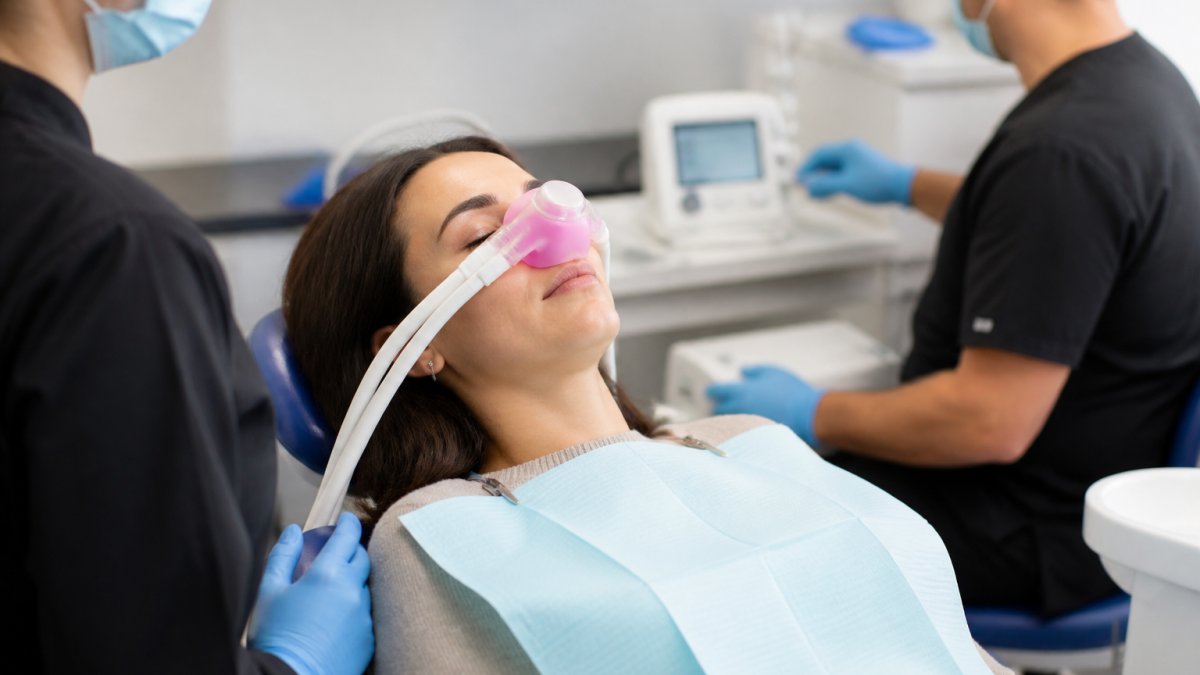
Nitrous oxide is inhaled through a small mask over your nose and produces relaxation within minutes. You stay awake and can respond to your dentist the whole time. The effect wears off quickly once the mask comes off, so many people can drive themselves home afterward.
It suits mild nerves and short procedures like a filling or cleaning. What most guides miss is that laughing gas alone does not help patients with a strong gag reflex or deep fear, and it does not provide pain control. Your dentist still uses local anesthesia for that.
Oral Conscious Sedation
Oral conscious sedation uses a pill, often a sedative like Halcion or Valium, taken before your appointment. You become drowsy and relaxed but remain conscious and able to respond. It is a good middle ground for moderate anxiety or longer appointments.
The trade-off is timing. The medication takes time to work, the dose has to be set in advance, and the effects last for hours. You will need someone to drive you home and stay with you afterward. Follow your dentist’s fasting instructions exactly before your appointment.
IV Sedation for Tooth Extraction and Complex Work
IV sedation delivers medication directly into the bloodstream, so it works fast and the level can be adjusted during the visit. You are deeply relaxed and often remember little of the procedure. IV sedation is one option that may be discussed for wisdom teeth removal, multiple extractions, and implant placement.
Recovery is the part patients ask about most. You will feel groggy for several hours and need an escort home. If you are planning an extraction, our guide to aftercare tips for wisdom teeth removal walks through what to expect day by day. Facing implant work instead? Our dental implant recovery timeline and pain guide sets out a realistic picture.
Sedation Dentistry Safety: Screening, Monitoring, and Side Effects
Safety starts before any medication is given. Sedation dentistry safety depends on a thorough medical history review, the right dose for your health, and monitoring during the procedure. Your provider should ask about heart conditions, sleep apnea, medications, allergies, and past reactions to sedation.

During treatment, a qualified team tracks your breathing, oxygen level, and blood pressure. Common side effects include drowsiness, dry mouth, and mild nausea, and most fade within a day. Watch out: skipping the medical history conversation or downplaying a medication you take can lead to a dose that is wrong for you. Tell your dentist everything.
Sedation Versus General Anesthesia: What’s the Difference
Sedation and general anesthesia are not the same thing. With sedation, you are relaxed but usually still breathing on your own and can respond. With general anesthesia, you are fully unconscious and a dedicated anesthesia professional manages your airway and breathing (General anesthesia: MedlinePlus Medical Encyclopedia).
Most routine dental work, even with IV sedation, does not require general anesthesia. It is reserved for specific situations, such as certain hospital-based procedures or patients with particular medical needs. MedlinePlus overview of conscious sedation explains the distinction in plain terms. If a provider suggests general anesthesia for a simple filling, ask why.
Alternatives to Medication-Based Sedation
Not everyone wants medication, and you do not have to accept it to get comfortable care.
|
Approach |
How It Works |
Best For |
Limits |
|---|---|---|---|
|
Communication plan |
Agree on a stop signal, breaks, and a description of each step before treatment starts |
Mild anxiety, first visits, fillings and cleanings |
Does not reduce strong gag reflex or deep fear |
|
Guided breathing |
Slow, counted breathing lowers heart rate and muscle tension |
Mild to moderate anxiety, short appointments |
Requires practice; less effective during long or painful work |
|
Distraction |
Noise-canceling headphones, music, or video to block drill sounds and sights |
Mild anxiety, routine care |
Does not address pain or severe fear |
|
Topical numbing |
Gel applied before the local anesthesia injection |
Needle anxiety, injections |
Only addresses the injection, not the procedure |
|
Staged appointments |
Shorter visits scheduled close together to build tolerance |
Moderate anxiety, multiple treatments needed |
Takes more calendar time and may cost more in visit fees |
|
Pre-visit tour |
Seeing the room and meeting the team before treatment day |
Fear of the unknown, pediatric or adult first visits |
Does not replace pain control during treatment |
Behavioral techniques work through predictability.
Guided breathing lowers sympathetic nervous system activity. Slow, controlled breathing may help some people feel calmer during stressful moments.
Distraction blocks the sensory triggers that amplify anxiety, especially the sound of the drill and the sight of instruments. Noise-canceling headphones with music or a podcast are the most common tool.
Topical numbing gel applied before the local anesthesia injection reduces the pinch that many patients fear most. It is quick, inexpensive, and widely available, but it only addresses the injection itself.
Staged appointments break treatment into shorter visits so no single appointment feels overwhelming.
A pre-visit tour lets you see the treatment room, meet the team, and ask questions before any instruments are in your mouth.
Watch out: choosing a non-medication approach for a procedure that genuinely needs deeper sedation, such as a surgical extraction, can turn a manageable appointment into a traumatic one.
For patients new to sedation, a plain-language primer on what sedation dentistry for adults actually involves can help you decide whether medication is even necessary.
Costs, Insurance, and What to Compare Between Providers
Sedation pricing can vary by type, provider, and appointment length. You can still compare providers intelligently by understanding what drives the cost and what a complete quote should include.
Cost drivers fall into four categories. Factors that can affect sedation cost include the sedation method, appointment length, provider type and credentials, and facility and monitoring requirements. Exact fees depend on your individual case and should be confirmed with our office.
What a complete quote should include. Ask for a written estimate that separates the sedation fee from the procedure fee, the exam and imaging costs, and any facility or monitoring charges.
Insurance questions to ask. Coverage for sedation is inconsistent. Coverage for sedation varies by plan. Check with your insurer about what your specific plan covers.
How to compare providers. Build a simple comparison sheet with columns for sedation methods offered, who monitors the patient and their training, the written quote components, insurance pre-authorization support, and appointment logistics such as wait time and escort requirements.
We do not publish fixed sedation prices because every case differs; call our office for a current quote and a written estimate that separates each fee.
Questions to Ask a Sedation Dentist Before You Book
The right questions separate a careful provider from a rushed one. Ask these before you commit:
- Who monitors me during sedation, and what is their training?
- What is your plan if I have a reaction?
- Which sedation level do you recommend for my procedure, and why?
- What are the fasting and escort-home requirements?
- Is the sedation fee separate, and what will my insurance cover?
- How many of these cases do you handle in a typical month?
If you are still narrowing down where to go, our guide on how to find a dentist for tooth pain near you covers what to check. A provider who answers these questions clearly and without pressure is a good sign. One who dodges them is not.
Schedule a Sedation Consultation at Canyon Dental
Choosing a sedation provider is a decision about trust as much as technique. If dental fear has kept you out of the chair, you deserve a team that takes it seriously and explains every step before it happens.
At Canyon Dental, sedation is provided in-house by our certified team, and your consultation, treatment, and follow-up are handled under one roof. We are glad to answer your questions before your visit.
Get started with Canyon Dental and schedule a sedation consultation to find the comfort level that fits you.
Frequently Asked Questions
How long does a tooth extraction take with IV sedation?
Extraction duration depends on the tooth and its position. IV sedation adds time before and after the procedure for IV placement, onset of the medication, and monitored recovery. Your provider can give you an estimate for your appointment. You will need a responsible adult to drive you home and stay with you for several hours, and you should not drive, work, or sign documents until the effects fully wear off.
Is sedation dentistry safe?
Sedation dentistry safety depends on proper candidate screening, the training of the provider, and monitoring during the appointment. Nitrous oxide is the lightest option and wears off within minutes. Oral conscious sedation and IV sedation require a full medical history review, including medications, allergies, sleep apnea, and heart or lung conditions. Ask your provider how breathing, oxygen levels, and blood pressure are monitored during your appointment. Ask who will monitor you, what emergency equipment is on site, and whether the provider holds a sedation permit.
What is the difference between dental sedation and general anesthesia?
Sedation keeps you conscious or lightly asleep and able to respond, while general anesthesia renders you fully unconscious with no protective reflexes, typically requiring an anesthesiologist and a hospital or surgical suite. Most dental work, including many extractions and implant placements, is done with local anesthesia plus one of the sedation options: nitrous oxide, oral conscious sedation, or IV sedation. General anesthesia is reserved for specific cases and is not the same service as in-office sedation dentistry.
Can sedation dentistry help with dental anxiety?
Sedation may help some people who experience dental anxiety feel more comfortable during treatment. Nitrous oxide takes the edge off for mild anxiety, oral conscious sedation (such as Halcion or Valium taken before the appointment) helps patients who dread the chair, and IV sedation is used for severe phobia or long procedures. Pair sedation with a provider who explains each step and lets you set a stop signal, and ask about a no-pressure consultation first.
Sedation is not a luxury, and it is not a last resort. It is one tool among several, and the right provider will help you choose it carefully rather than push it. If you have been putting off care because of fear, book a consultation with Canyon Dental and let us walk you through the options before you decide.