Last Updated: November 5, 2026
Quick Summary
Full mouth reconstruction before and after photos show the shift from worn, damaged, or missing teeth to a rebuilt, functional smile, but they capture only one angle and moment. A credible result restores vertical height and symmetry together, with function rebuilt before appearance is refined.
- Read before photos for remaining tooth structure, even tooth heights, and midline alignment.
- Full mouth reconstruction is a customized plan rebuilding every tooth, not a single treatment.
- Implants replace missing tooth roots with titanium posts capped by matching crowns.
- Veneers come last in the sequence, after bite function is stabilized.
- The full process often spans several months, and implant cases take longer.
Table of Contents
- What Full Mouth Reconstruction Before and After Photos Actually Show
- What Full Mouth Reconstruction Includes
- Dental Implants Before and After Pictures: Replacing Missing Teeth
- Porcelain Veneers Before and After: Refining the Final Smile
- Full Mouth Crowns Cost and What Drives the Price
- Full Mouth Restoration Recovery and Treatment Timeline
- Candidacy, Risks, and Alternatives in Orem
- Schedule a Full Mouth Reconstruction Consultation
- Frequently Asked Questions
What Full Mouth Reconstruction Before and After Photos Actually Show
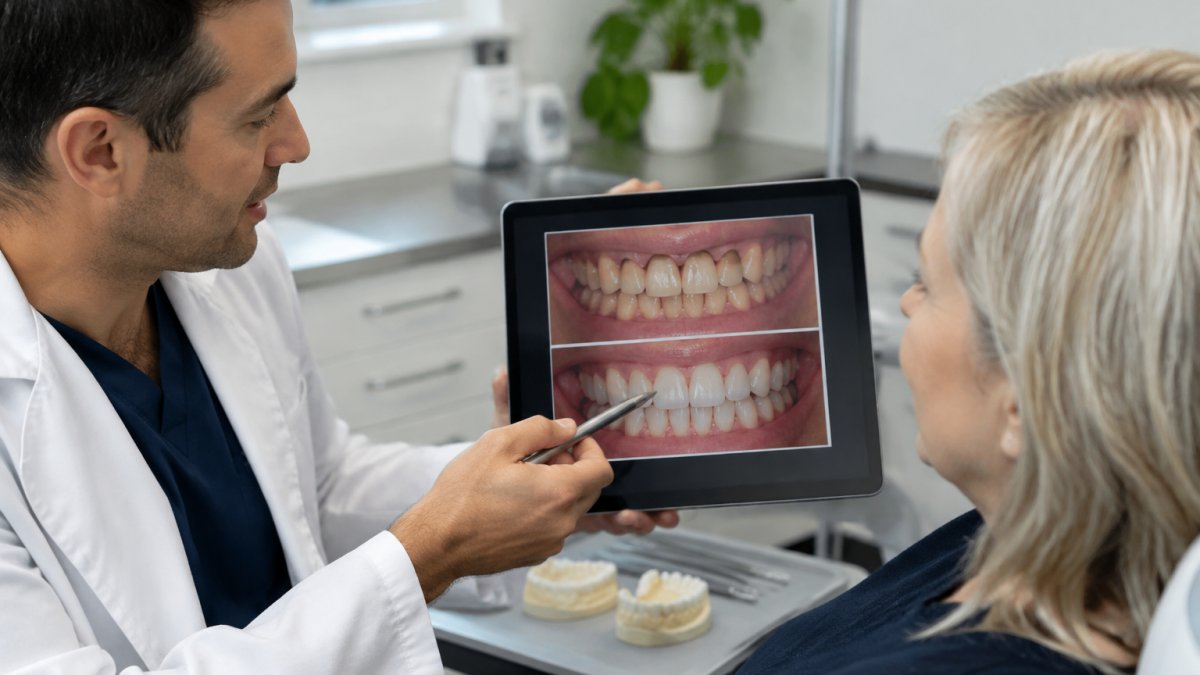
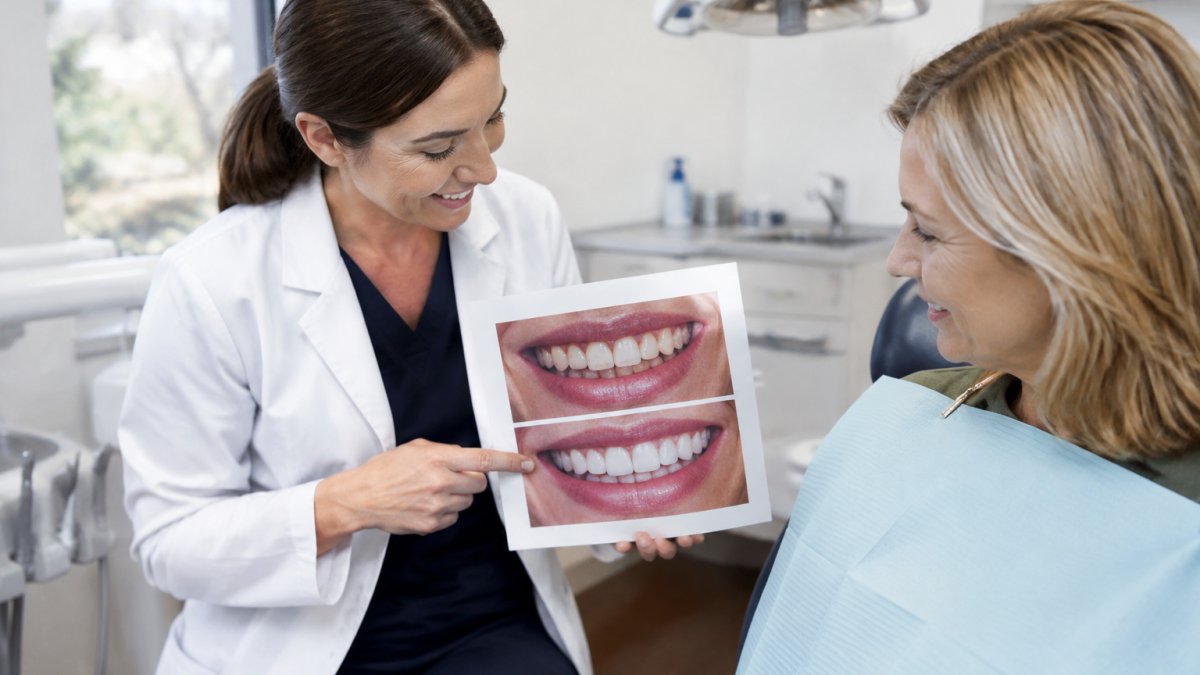
Full mouth reconstruction before and after photos document the shift from worn, damaged, or missing teeth to a rebuilt, functional smile. These images are best read as clinical records first and inspiration second. You can also view before and after photos from our practice to see the results previous patients have had with us. They show what changed, not just that something changed. (Source: National Institute of Dental and Craniofacial Research on oral health statistics)
Here is the honest part most galleries skip: a photo captures one angle, one lighting setup, one moment. It cannot show you bite stability, jaw joint comfort, or how the restorations hold up under chewing force. Those are the outcomes that matter most, and they live in the treatment record, not the image.
Reading a Before and After Photo Like a Clinician
Start with the “before” image and look at three things: how much tooth structure remains, whether the teeth sit at even heights, and how the midline aligns with the face. Then compare the “after.” A credible result restores vertical height and symmetry together. If the after smile looks bright but the bite still looks shallow, the cosmetic work outpaced the functional work.
What Full Mouth Reconstruction Includes
Full mouth reconstruction is a customized plan that rebuilds every tooth in the upper and lower arches, combining restorative and cosmetic procedures into one coordinated sequence. It is not a single treatment. It is a treatment plan.
The building blocks usually include crowns, bridges, implants, and veneers, sometimes paired with bite correction or gum work. Plans typically begin with a comprehensive evaluation covering imaging, bite analysis, gum health, and a conversation about what the patient wants the smile to do and look like. Function is generally restored before appearance is refined.
That order matters. Cosmetic dentistry layered onto an unstable bite tends to fail early.
Dental Implants Before and After Pictures: Replacing Missing Teeth
Dental implants before and after pictures tend to be the most dramatic in any gallery, because they show gaps closing and chewing function returning. An implant replaces a missing tooth root with a titanium post, then caps it with a crown that matches its neighbors.
For patients missing most or all of an arch, full mouth dental implants can support a complete set of replacement teeth. Implant placement, healing, and final restoration generally happen in stages, and the bone needs time to integrate before the final crown goes on.
If you are comparing photos, look at gum line symmetry and how naturally the implant crown blends with adjacent teeth. Those details separate a good result from a great one.
Porcelain Veneers Before and After: Refining the Final Smile
Porcelain veneers before and after images usually come last in a reconstruction sequence, and that is deliberate. Veneers are thin ceramic shells bonded to the front of teeth to correct color, shape, and minor alignment. They are the finishing touch, not the foundation.
A common mistake is treating veneers as the whole plan. Bonding veneers onto teeth with untreated wear or bite problems shortens their lifespan. Stabilizing function first and then refining appearance with porcelain veneers is a commonly described sequence.
What most guides miss: the best veneer results look slightly imperfect. Perfectly uniform teeth read as artificial.
Full Mouth Crowns Cost and What Drives the Price
Full mouth reconstruction cost depends on the specifics of each case. What a patient pays generally depends on how many teeth need restorations, whether implants or extractions are involved, the materials chosen, and how much preparatory work the bite and gums require. Because full mouth reconstruction is a customized treatment plan rather than a package, pricing depends on the diagnostic records of each patient. For current pricing or a quote, please contact Canyon Dental directly.
The main cost drivers:
- Number of restorations – a full arch requires far more laboratory and chair time than a few crowns, and the count changes the total more than any other factor.
- Implant vs. crown-and-bridge – implants add surgical placement, healing time, and abutment components; crown-and-bridge work avoids surgery but depends on healthy supporting teeth.
- Materials – porcelain fused to metal, all-ceramic, and zirconia restorations carry different laboratory costs and different wear characteristics against opposing teeth.
- Prep work – gum treatment, bite correction, extractions, and bone grafting are separate stages that add cost before the final restorations are even designed.
- Sedation and visit count – complex cases often need longer or more frequent appointments, and sedation dentistry adds a line item.
Insurance coverage is often a point of confusion for patients. Dental plans vary, but many cover a percentage of restorative work after a deductible, frequently exclude cosmetic elements, and may cap annual benefits. Patients should check their own plan’s terms and ask their dental office about how it handles insurance questions before committing.
Financing questions worth asking any dental office include: Does the practice offer payment plans or third-party financing? Are payments spread over months with interest, and is there a prepayment discount? What happens to the plan if a stage is delayed? Patients can learn about dental crowns and bridges options and what each involves so they can plan realistically.
Several factors determine what a full mouth reconstruction costs, and each one changes the total in a different way.
| Cost driver | Effect on price |
|---|---|
| Number of restorations | Full arch needs far more lab and chair time |
| Implant vs. crown-and-bridge | Implants add surgery, healing time, abutment components |
| Materials | Porcelain fused to metal, all-ceramic, zirconia differ in lab cost |
| Prep work | Gum treatment, bite correction, extractions, bone grafting add cost |
| Sedation and visit count | Longer or more frequent appointments; sedation adds a line item |
Full Mouth Restoration Recovery and Treatment Timeline
Full mouth restoration recovery is staged, not a single downtime. Most patients move through a sequence: consultation and planning, preparatory work, surgical phases if implants are involved, healing, and final restorations. The full process often spans several months, and implant cases take longer than crown-only cases because bone healing cannot be rushed.
Discomfort is usually manageable with prescribed medication and soft foods during healing windows.
Follow-up care decides the long-term result. Regular cleanings, nightguard use if you grind, and prompt attention to any loose restoration keep the work intact for years.
Candidacy, Risks, and Alternatives in Orem
Not everyone needs full mouth reconstruction, and not everyone is a candidate. Candidacy is determined through clinical evaluation rather than preference. Good candidates typically have multiple worn, cracked, missing, or failing teeth along with bite problems that affect chewing, speech, or jaw comfort. The evaluation that confirms this usually includes a comprehensive exam, full-mouth radiographs or a cone-beam CT scan for implant planning, periodontal probing to measure gum health, a bite assessment to see how the upper and lower teeth meet, and photographs and models to document the starting point. Oral-health factors matter: uncontrolled gum disease, active decay, smoking, and certain medical conditions can change the sequence or rule out some options until they are addressed.
Risks are real and worth naming. Implant failure can occur when bone does not integrate or when infection develops around the site. Restoration fracture is possible under heavy bite forces, especially in patients who grind. Bite changes after reconstruction sometimes need adjustment visits before comfort settles. Gum recession around crowns and implant margins can expose edges over time. Most practitioners find these risks are manageable with careful planning, but they are not zero, and a plan that ignores them is incomplete.
Alternatives depend on what is failing. Partial reconstruction may address only the teeth causing active problems. Removable dentures can replace missing teeth without surgery, at the cost of stability and bone preservation. Addressing only the most urgent teeth is a legitimate staged approach when budget or health limits the full plan.
Schedule a Full Mouth Reconstruction Consultation
The photos you have seen are the end of someone else’s story. Yours starts with an exam, imaging, and an honest conversation about what is possible.
Canyon Dental brings over a decade of experience, an in-house dental lab for custom restorations, same-day smile protocols, and certified sedation dentistry for patients who need it. The practice’s doctors are Creighton University School of Dentistry graduates with advanced training in oral surgery and implants at Parkland Hospital.
Ready to see what your smile could look like? Contact us to schedule a consultation and get a personalized treatment plan.
Frequently Asked Questions
Is full mouth reconstruction worth it?
For patients with worn, damaged, or missing teeth, full mouth reconstruction can restore chewing function, bite alignment, and speech while improving smile appearance. Before and after photos show the cosmetic change, but the bigger benefit is often comfort and function. Whether it is worth it depends on your oral health, goals, and budget. A comprehensive evaluation with a dentist is the best way to know if the results justify the treatment for your case.
How long does a full mouth restoration take from start to finish?
Timelines vary by case. Some full mouth restoration recovery and treatment plans run several months because implants need time to integrate with bone and crowns or veneers are custom-fabricated. Your dentist will map out a customized treatment plan after a comprehensive evaluation, including staging for healing and follow-up care.
Is full mouth reconstruction painful?
Most procedures use local anesthesia, and sedation dentistry is available for patients with dental anxiety. Expect some soreness and swelling after surgical steps like extractions or implant placement, which typically eases over days. Your care team will give you aftercare instructions and follow-up support. Pain levels differ by procedure and individual, so discuss your concerns and sedation options at your consultation.
Do dental implants before and after pictures show permanent results?
Dental implants are designed to be a long-term tooth replacement, and before and after pictures often show stable results years later. Longevity depends on oral hygiene, regular checkups, and bite alignment. Crowns and veneers may need repair or replacement over time. Ask your dentist about maintenance and follow-up care so your restored smile stays healthy and functional.
A rebuilt smile is a medical outcome first and a cosmetic one second, and the right plan balances both. If you have been putting off care because you are unsure what full mouth reconstruction involves or what it costs, start with a conversation rather than a guess. Get started with Canyon Dental and find out what a customized plan for your smile actually looks like.