Last Updated: November 12, 2026
Quick Summary
For straightforward single-tooth dental implants with adequate bone and good health, a trained family dentist is often the better choice because one provider plans, places, and restores the tooth. Complex cases involving bone grafting, sinus lifts, or full-arch restoration are best referred to an oral surgeon.
- Family dentists build implant skills through continuing education; oral surgeons complete a multi-year surgical residency.
- Ask providers how many implants they placed in the last 12 months, split by single-tooth versus full-arch.
- Verify a Utah provider’s license through the Utah DOPL lookup and ask about board certification.
- A low advertised implant price often excludes the abutment, crown, grafting, or scan.
- Ask who designs the final crown and whether they see the surgical plan first.
Table of Contents
- Who Can Place Dental Implants in Utah County
- Oral Surgeon vs Family Dentist: Training and Qualifications Compared
- When a Family Dentist Is the Right Choice for Implant Placement
- When an Oral Surgeon Is Recommended for Complex Cases
- Dental Implant Bone Graft: Why Some Patients Need One
- Dental Implant Crown and Abutment: Who Handles the Final Restoration
- Dental Implant Consultation Questions to Ask in Orem
- Dental Implant Recovery Time and Follow-Up Care
- Frequently Asked Questions
Who Can Place Dental Implants in Utah County
Dental implants in Utah County are placed by two groups of providers: general and family dentists who have pursued implant-specific surgical training, and oral and maxillofacial surgeons, the specialists whose entire practice is built around surgical procedures in the mouth and jaw. Both can legally place an implant. The real question is which one fits your case.
At Canyon Dental in Orem, we place implants and also refer out when a case calls for it. That referral habit is the honest answer to this question: the right provider depends on your bone, your health history, and how complex the site is.
Below, we walk through the training differences, the cases each provider handles best, and the questions to ask before you commit.
Oral Surgeon vs Family Dentist: Training and Qualifications Compared
A general dentist completes four years of dental school and then builds implant skills through continuing education, hands-on courses, and supervised casework. An oral and maxillofacial surgeon completes dental school plus a hospital-based surgical residency of several years, often including anesthesia training and rotations in medicine and general surgery. Both paths can produce a capable implant provider, but the training is not equivalent, and the difference shows up in specific situations.
That gap matters most in three areas: surgical volume, complication management, and sedation. Oral surgeons generally perform a higher volume of surgical procedures, and that breadth of surgical experience is one reason referral is often recommended for complex cases. Family dentists who place implants can offer continuity of care, since they are often already familiar with your bite, gum history, and other teeth. The American Dental Association’s guidance on dental specialties is a useful starting point for understanding how specialty recognition works.
| Factor | Family Dentist with Implant Training | Oral and Maxillofacial Surgeon |
|---|---|---|
| Core training | 4 years dental school | Dental school plus multi-year surgical residency |
| Surgical volume | Moderate, case-dependent | High, procedure-focused |
| Sedation options | Often limited or referral-based | Typically broader anesthesia scope |
| Bone grafting and sinus lift | Varies by practice | Routine part of practice |
| Continuity of care | High, same office for restoration | Often returns you to your dentist |
| Best for | Straightforward single-tooth sites | Complex anatomy, grafting, full-arch cases |
How to verify a Utah County implant provider’s qualifications. Credentials on a website tell you what a provider has studied, not how many of a given procedure they perform each month. In Utah, you can confirm an active dental license through the Utah Division of Occupational and Professional Licensing (DOPL) license lookup.
A common pattern in Orem and across Utah County is a family practice that places straightforward single-tooth implants in-house and refers grafting, sinus lifts, and full-arch cases to an oral surgeon.
Watch out: A weekend implant course and a multi-year surgical residency both produce a certificate, but they do not produce the same complication-management experience. Ask what the practice does if an implant fails, who handles after-hours emergencies, and whether the provider has a written referral relationship with a local oral surgeon.
When a Family Dentist Is the Right Choice for Implant Placement
For a straightforward single-tooth implant with adequate bone and a healthy medical history, a trained family dentist is often the better choice, and not just for convenience. One provider plans the surgery, places the implant, and restores the tooth, so nothing gets lost in a handoff.
The advantages are practical:
- One treatment plan. No translation errors between a surgeon’s report and a restorative plan.
- Fewer appointments. Placement and restoration happen under one roof.
- Familiar history. Your dentist already knows how your gums heal and how your bite loads.
- Coordinated imaging. The same practice evaluates bone and designs the crown.
The thing nobody tells you about implant shopping is that most straightforward cases never needed a specialist in the first place. What they needed was a dentist who places implants regularly and knows when to stop.
When an Oral Surgeon Is Recommended for Complex Cases
Complex implant cases belong with a surgeon. That includes significant bone loss, a history of failed implants, uncontrolled medical conditions, heavy smoking combined with grafting needs, or full-arch restoration where multiple implants must be positioned precisely.
Other triggers for referral:
- Sinus lift required in the upper back jaw
- Extraction with immediate grafting at an infected site
- Nerve proximity that demands careful surgical mapping
- IV sedation for anxious patients or long procedures
Complexity is not a judgment on your dentist. It’s a recognition that surgical precision under difficult anatomy is a skill sharpened by volume. If your case involves bone grafting or a sinus augmentation, ask who performs that step and where. Our team includes dentists with advanced training in oral surgery and implants at Parkland Hospital. For cases beyond our scope, we refer out and stay involved in the restorative plan. You can review our oral surgery services in Orem to see what we handle directly.
Dental Implant Bone Graft: Why Some Patients Need One
A dental implant bone graft is a procedure that adds or rebuilds jawbone so an implant has enough stable bone to anchor into. Because bone grafting can add complexity to implant treatment, it is worth considering how the dentist’s training and experience fit your needs, as Royal Dental at The Villages notes.
Bone loss happens for predictable reasons: a tooth extracted years ago, gum disease, infection, or simply the natural shrinkage that follows tooth loss. The jawbone responds to load, and a missing tooth removes that load.
Grafting options range from minor socket preservation at the time of extraction to larger block grafts and sinus augmentation for the upper jaw. Healing time before implant placement varies by graft type and site, and your provider will advise on your timeline.
The National Institute of Dental and Craniofacial Research overview of dental implant care explains the biological process behind implant healing in plain terms.
Dental Implant Crown and Abutment: Who Handles the Final Restoration
The implant crown and abutment are the visible and connective parts of the restoration. The abutment is the small connector that sits on the implant, and the crown is the tooth-shaped cap attached to it. Together they turn a titanium post into something that looks and chews like a tooth.
Here’s where care often fragments. An oral surgeon places the implant and clears you. Months later, a restorative dentist takes impressions and orders the crown. If the implant angle and the crown design weren’t planned together, adjustments follow.
Ask this before surgery: who designs the final crown, and do they see the surgical plan first? Practices with an in-house dental lab, like ours, can design the restoration around the actual implant position rather than working backward. If you want a deeper explanation of how the connector works, read our guide to understanding your abutment on an implant.
Dental Implant Consultation Questions to Ask in Orem
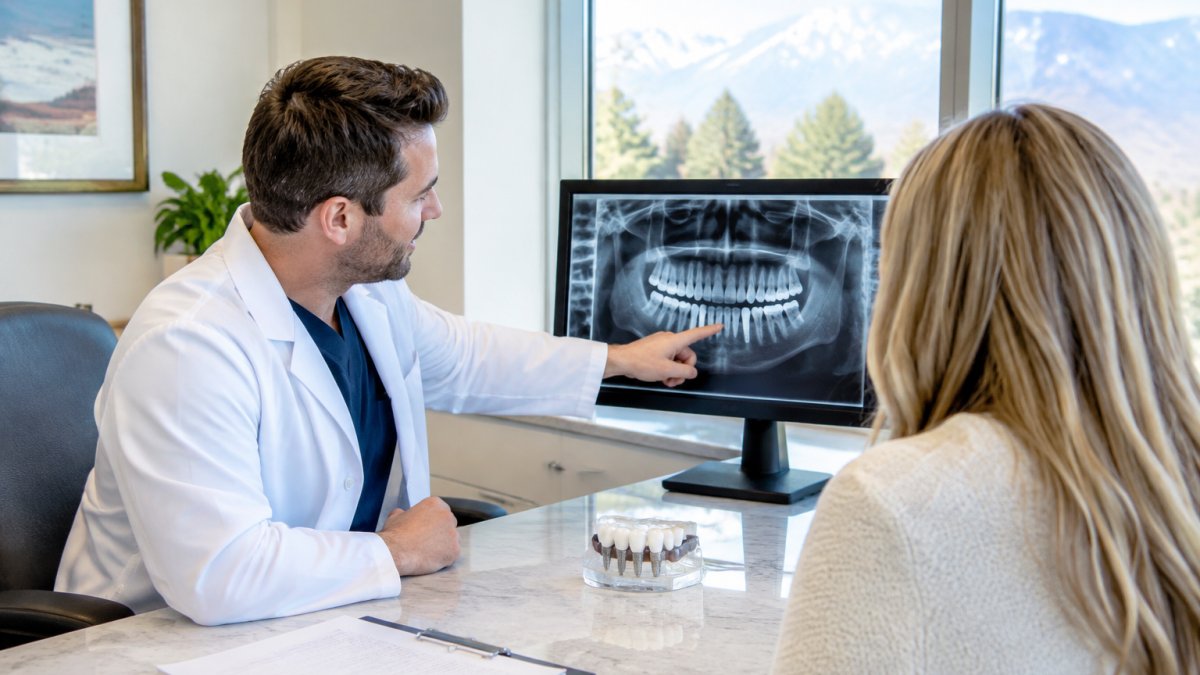
Bring a written list to your dental implant consultation. The answers tell you more about a provider than any brochure.
- How many implants have you placed in the last year? Look for a specific number, not “many.” Ask how many were single-tooth versus full-arch.
- Who performs the bone graft if I need one? You want a named provider and a clear location, in-house at the Orem office or at a separate surgical suite.
- What imaging do you use for planning? Ask which imaging is used for implant planning and whether it is included in the quoted fee or billed separately.
- What sedation options do you offer? Ask whether sedation is available in-house or through a referral, and whether it is included in the treatment estimate.
- What happens if the implant fails? A frank answer about revision policy and any warranty builds trust.
- Who makes the final crown, and where? In-house lab, local lab, or outsourced all have different timelines and fees.
- What is the total plan, start to finish? You want the sequence, the number of visits, and an itemized written estimate, not a single bundled number.
Cost and insurance questions specific to Utah County. Implant pricing depends on the individual case, so ask for a written treatment plan that separates each component. For a step-by-step walkthrough of booking, see our guide on how to schedule a dental implant consultation in Orem.
Coordination questions if your surgeon and dentist are different providers. Ask who sends the surgical report to the restorative dentist, who schedules the restoration appointment, and who owns the follow-up if healing stalls. A good answer names the person and the timeline.
Watch out: A low advertised implant price in Utah County often excludes the abutment, the crown, grafting, or the scan. Compare itemized written estimates, not headline numbers, and confirm what happens to the fee if grafting is needed after the scan.
Dental Implant Recovery Time and Follow-Up Care
Recovery varies by patient and procedure. Full healing of the bone around the implant takes months, and your provider will explain what to expect for your case.
Follow-up care follows a predictable rhythm:
- First week: check for swelling, bleeding, and healing at the site
- Two to four weeks: soft tissue healing review
- Three to six months: osseointegration check before restoration
- After restoration: bite checks and hygiene visits
Factors such as smoking, uncontrolled diabetes, and poor oral hygiene can affect healing. Discuss your own health history with your provider. If you want the full picture of the procedure day itself, read what to expect during dental implant surgery.
Choosing between an oral surgeon and a family dentist for implants comes down to your case, not a ranking. Straightforward sites often do best with one provider who plans and restores. Complex anatomy deserves a surgeon’s hands. What you should never accept is a vague answer about who does what.
Frequently Asked Questions
Is it better to get dental implants from an oral surgeon or a general dentist?
There is no single better choice. A general dentist with implant training can handle straightforward single-tooth implants, while an oral surgeon is the safer referral for complex cases involving bone grafting, sinus lifts, or full-arch restoration. The right provider depends on your jawbone condition, medical history, and how complex the placement is. Ask both about their surgical training, how many implants they place yearly, and who handles the crown afterward.
Can a family dentist place dental implants?
Yes, many family dentists place dental implants, but the scope varies by practice. Some complete the entire process from surgery to crown, while others place the implant and refer the restoration to a prosthodontist or oral surgeon. Ask directly whether your dentist performs the surgical placement in-house or coordinates with a specialist. Canyon Dental, for example, handles implants and restorations under one roof with in-house sedation and lab services.
Do I need a dental implant bone graft before getting an implant?
Not always, but many patients do. Bone grafting adds volume to the jawbone when it has shrunk from tooth loss, gum disease, or long-term denture wear. Without enough bone, an implant cannot anchor securely. Your provider will evaluate bone density with imaging during a consultation and tell you whether a graft is needed. Grafts typically add healing time before implant placement, so plan for that in your recovery timeline.
What should I ask a dentist before choosing an implant provider in Utah County?
Ask about their surgical training and continuing education in implant dentistry, how many implants they place each year, and whether they handle bone grafting and sinus lifts in-house. Also ask who places the crown and abutment, what sedation options are available, and how follow-up care works. Request before-and-after photos of complex cases and ask how complications are managed. A provider who answers these clearly is usually a good fit.